The Protection Lab (Expert Insights)

UV Degradation Test: Engineering Fabrics to Resist the Desert Sun
Sunlight Is a Chemical Weapon
When a cover fails after a summer in Arizona or the Middle East, most users blame "cheap material." The real culprit is physics: ultraviolet radiation is energetic enough to break chemical bonds. UV-B photons (280-315nm) carry enough energy to sever the polymer chains in polyester, polypropylene, and coating films, while UV-A (315-400nm) drives slower but relentless degradation. The result is fabric that becomes brittle, cracks, fades, and loses tensile strength — often invisibly, until it fails catastrophically. At JK Covers, we don't hope our fabrics resist the sun; we prove it in accelerated weathering labs.
The Degradation Mechanism, Explained
Photodegradation follows a chain reaction. UV photons energize electrons in polymer molecules, creating free radicals — unstable molecular fragments that attack neighboring chains. Left unchecked, this cascade breaks the polymer backbone, reducing molecular weight and destroying mechanical strength. Visible symptoms include:
- Fading: Dye molecules absorb UV and break down, shifting color.
- Crazing and cracking: Embrittlement of yarns and coatings as chain scission progresses.
- Chalking: Powdered residue on coated fabrics as surface layers degrade.
- Loss of tear strength: The most dangerous failure — fabric that rips in the first storm.
How We Fight Back: UV Stabilization Chemistry
UV resistance is engineered into the material at three levels:
- UV absorbers (UVAs): Chemical additives that absorb harmful wavelengths and dissipate the energy as harmless heat before it can attack polymer chains.
- HALS (Hindered Amine Light Stabilizers): Radical scavengers that intercept free radicals and interrupt the degradation cascade — the most effective stabilizers for polypropylene and polyester.
- Solution-dyed yarns: Pigment is mixed into the molten polymer before fiber extrusion, rather than printed on the surface. The color — and its UV-blocking carbon black or titanium dioxide content — runs through the entire fiber, so even a worn surface remains protected.
The stabilizer package must be matched to the polymer. A UV absorber that protects polyester poorly may excel in nylon. This is why our material scientists formulate per-application rather than applying a one-size-fits-all additive. See [Link to Article 57: PU vs PVC Coatings] for how coating chemistry interacts with UV stabilizers.
The Lab: Xenon-Arc Accelerated Weathering
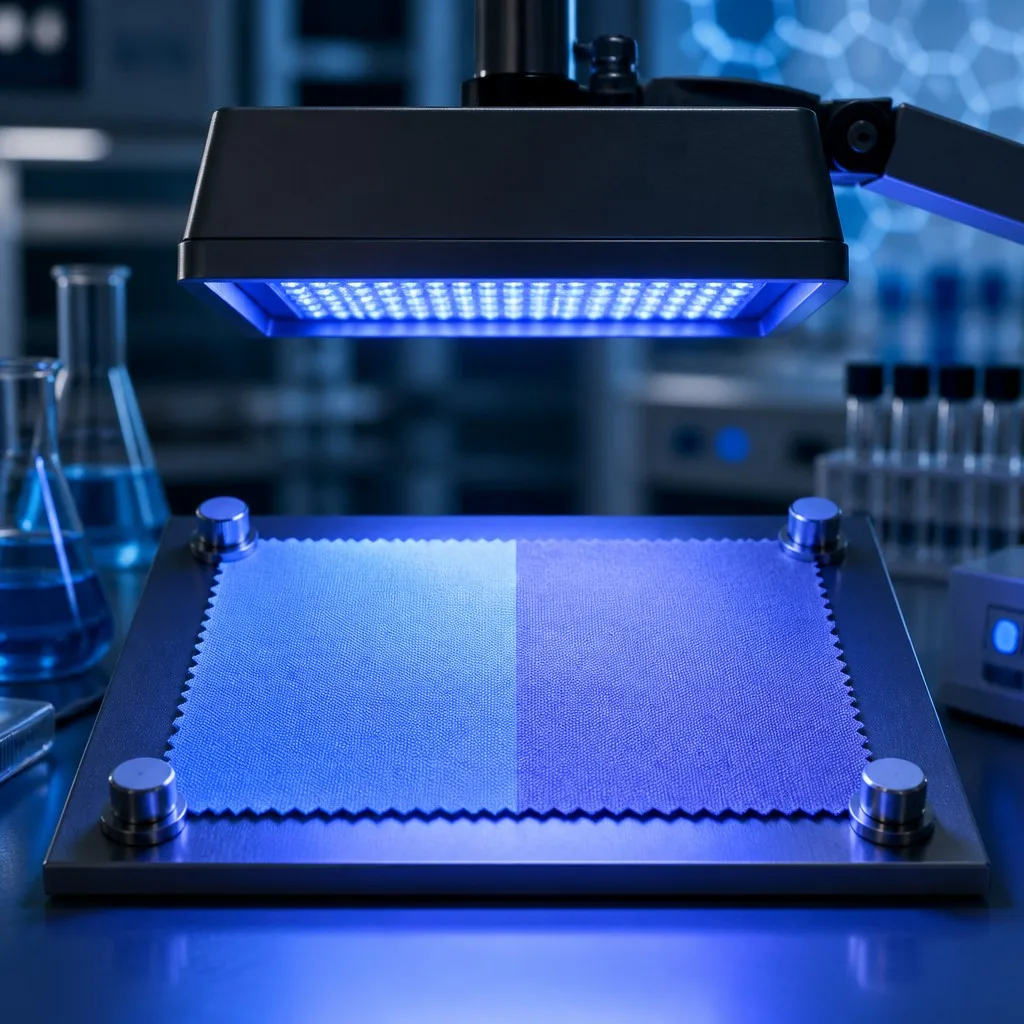
We cannot wait five years of real sun to validate a fabric — customers need answers in weeks. Instead, we use xenon-arc weathering chambers that reproduce the full solar spectrum, per ASTM G155 and ISO 4892-2 standards. The chamber cycles intense light, temperature (up to 70°C black-panel), and humidity to accelerate photodegradation. A general rule in the industry: 500-1,000 hours of xenon exposure approximates one year of outdoor weathering in a hot, sunny climate, though correlation varies by polymer and stabilizer package.
During and after exposure, our technicians measure:
- Tensile and tear strength retention — a fabric that keeps 80%+ of its strength after 1,000 hours passes.
- Colorfastness against the grey scale, checking both dye fade and yellowing.
- Surface inspection for crazing, cracking, and coating delamination.
Real-World Correlation: From Chamber to Desert
Accelerated testing is only meaningful if it correlates with reality, so we validate our chamber results against field trials in extreme-sun locations. Test panels mounted on vehicle roofs in Arizona, Dubai, and Australia are photographed and strength-tested at intervals, then compared with identical panels that have spent the same period in the xenon chamber. This calibration lets us predict, for any new formulation, how many months of outdoor desert life it will survive before losing half its tear strength. It also reveals surprises the chamber alone would miss — dust abrasion in dry climates, for example, acts as a slow sanding process that removes surface stabilizers and accelerates UV damage. Field correlation is the reason our desert-grade fabrics are formulated with heavier coatings, not just more stabilizer.
The Desert Scenario: Why Heat Compounds UV Damage
The desert sun is uniquely punishing because UV intensity and temperature arrive together. For every 10°C of temperature rise, photochemical reaction rates roughly double — so a fabric in Dubai at 50°C degrades far faster than the same fabric in a cooler climate with equal sunshine. This is why desert-market covers demand heavier denier plus robust stabilizer loading. See [Link to Article 55: 600D vs 900D Oxford Fabric] on why 900D is often specified for high-sun, high-wind regions. Light-colored fabrics also help: they reflect more solar radiation and run cooler, extending life.
What This Means for Your Purchase
When a supplier cannot show weathering data, treat their UV claims as marketing. Real UV resistance is measurable: ask for xenon-arc test reports, stabilizer specifications, and solution-dyed yarn documentation. At JK Covers, every outdoor-grade fabric we ship is batch-tested for UV performance, and OEM clients receive full test documentation with their orders — because in the desert, the test report is the only honest proof.
Engineering covers for hot climates? JK Covers provides UV-tested, stabilizer-formulated fabrics with full lab documentation. Contact our engineering team for desert-grade specifications.
0users like this.