Powersports & Bike Shields

How to Store an E-Bike Safely: Covering, Charging, and Battery Protection
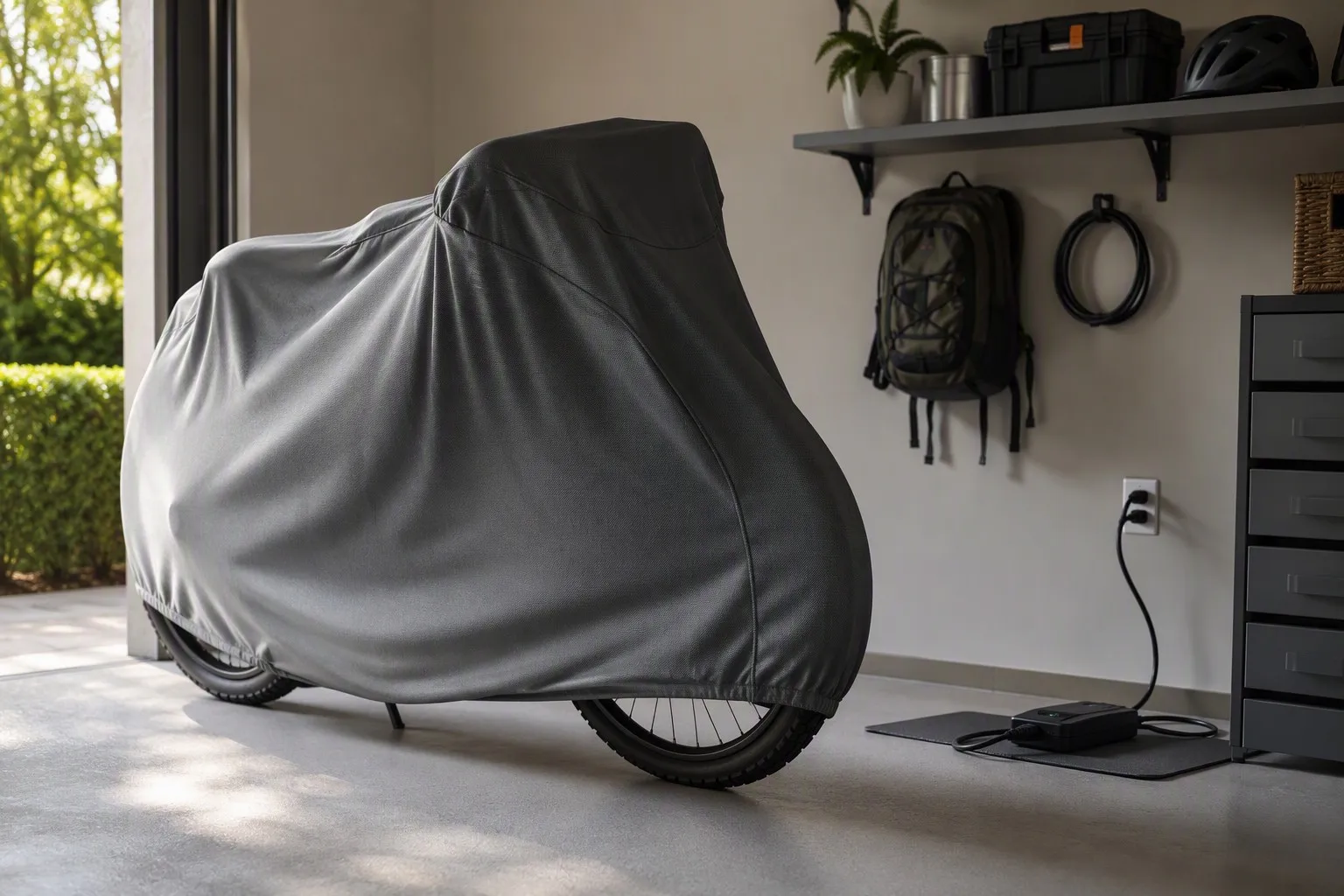
An E-Bike Is Not Just a Bicycle Anymore
An e-bike is the most valuable two-wheeler most households own — and the most sensitive to how it is stored. Between the battery, the display, the motor, and a wiring harness that runs the length of the frame, an e-bike has far more to lose from damp, dust, and sun than a conventional bicycle. Yet most riders store theirs the same way they stored their old mountain bike: leaned against a wall, fully charged, and forgotten. That approach costs money. A lithium battery left at 100% charge for months, a controller exposed to condensation, a display bleached by UV — each of these is a slow failure that a few minutes of careful storage prevents. At JK Covers, we build protection for two-wheelers of every kind, and the storage routine we recommend below applies whether your e-bike lives in a garage or under the sky.
Where Should the Battery Live?
The single most important storage decision for an e-bike is the battery. Modern lithium-ion packs prefer cool, dry, moderate conditions — roughly the temperature range a human would find comfortable. Extreme heat accelerates cell aging; extreme cold forces the battery to work harder when it is next used. If your e-bike sits for weeks or months, the ideal is to remove the battery and store it separately:
- Charge to 50-80%, not 100%. A full charge held for weeks stresses the cells and measurably shortens cycle life. Most manufacturers recommend a partial charge for long-term storage.
- Check monthly. A stored lithium pack slowly self-discharges. One short top-up per month keeps it out of the deep-discharge danger zone.
- Keep it dry and moderate. Never store a battery in direct sun, on a radiator, or in an unheated shed through a hard winter. A cool indoor shelf is ideal.
- Charge before riding, not after. A pack that is warm from riding should cool down before charging; a cold pack should not be fast-charged.
If the battery is non-removable, the same rules apply to the whole bike: store it in the coolest, driest place available, and never leave it on the charger after it reaches full charge.
Cleaning Before Covering
Never cover a dirty e-bike. Road grime holds moisture against paint, cables, and connectors, and that moisture is exactly what starts corrosion. Wipe down the frame, dry the chain and drivetrain, and pay attention to the charge port — a wet or gritty port is a short-circuit waiting to happen. Lubricate the chain, then let everything air-dry completely before the cover goes on. This is the same discipline we recommend for any stored vehicle; a clean machine under a dry cover stays healthy, while a damp one becomes a corrosion lab. For the full explanation of why trapped moisture is the enemy, see [Link to Article 60: Breathability vs Waterproofness: Preventing Mold Under Your Vehicle Shield].
Indoor Storage: Choose the Right Cover
Indoor storage still needs a cover, but not for the reason most people think. Indoors, the threats are dust, humidity, tools, and other bikes bumping against yours. A soft indoor cover keeps dust off the display and brake levers, prevents scratches from accidental contact, and slows the tarnishing of bright parts. For this job, a lighter non-woven or uncoated woven cover is often the better engineering choice than a heavy outdoor shell — it drapes easily and lets residual moisture escape. If your garage is damp, add a breathable cover rather than an airtight one; condensation trapped under any fabric is the most common cause of mildew damage. See [Link to Article 56: Oxford vs PEVA vs Non-Woven: The Ultimate Material Showdown] for how the material families compare on exactly this point.
Outdoor Storage: Weather Is the Real Test
Outdoor e-bike storage is where cover choice matters most. Rain, frost, UV, and wind will attack everything — frame, battery mount, display, and drivetrain. A proper outdoor cover for an e-bike should be:
- Waterproof but breathable. A coated Oxford fabric with a vent or breathable construction sheds rain while letting trapped air escape — the combination that prevents the "sauna under the cover" effect.
- UV-resistant. Even in cloudy climates, months of exposure fade paint and crack display housings and tires. UV-stabilized yarns slow that damage dramatically.
- Wind-secure. Elastic hems and buckle straps stop the cover from acting like a sail on windy nights — flapping fabric is how scratches and seam failures begin.
- Ground clearance. A cover that reaches below the wheel hubs keeps splash, spray, and puddle water off the drivetrain and motor casing.
One more outdoor warning: theft. A cover hides your e-bike's identity, which is genuinely useful, but it should never replace a lock. Always secure the frame and both wheels to a fixed anchor; some riders add a cable looped through the cover itself so a thief cannot simply lift the cover and see what they are working with.
Build a Seasonal Storage Checklist
The best storage routines are boring and repeatable. Before the season ends, or before any long absence, run this checklist:
- Charge the battery to a moderate level (50-80%) and store it separately if possible.
- Clean and dry the bike completely, including the charge port and drivetrain.
- Lubricate the chain and check tire pressure — soft tires flat-spot under the bike's weight.
- Choose the cover for the environment: soft non-woven indoors, breathable waterproof outdoors.
- Lock the bike regardless of covering, and check on it monthly.
None of these steps takes more than a few minutes, but together they are the difference between an e-bike that starts every spring like new and one that needs a new battery, new tires, and new paint. Storage is not where the ride ends — it is where the next ride is won or lost. For more on the covered-versus-uncovered decision, see [Link to Article 75: Covered vs Uncovered Motorcycle Storage: A Practical Protection Comparison].
Need breathable waterproof covers for e-bikes, motorcycles, or other two-wheelers, manufactured to your specification? Contact JK Covers for OEM and ODM consultation on powersports shielding.
0users like this.