Marine & Watercraft Gear

Pontoon Boat Care: Protecting the 'Living Room on the Water'
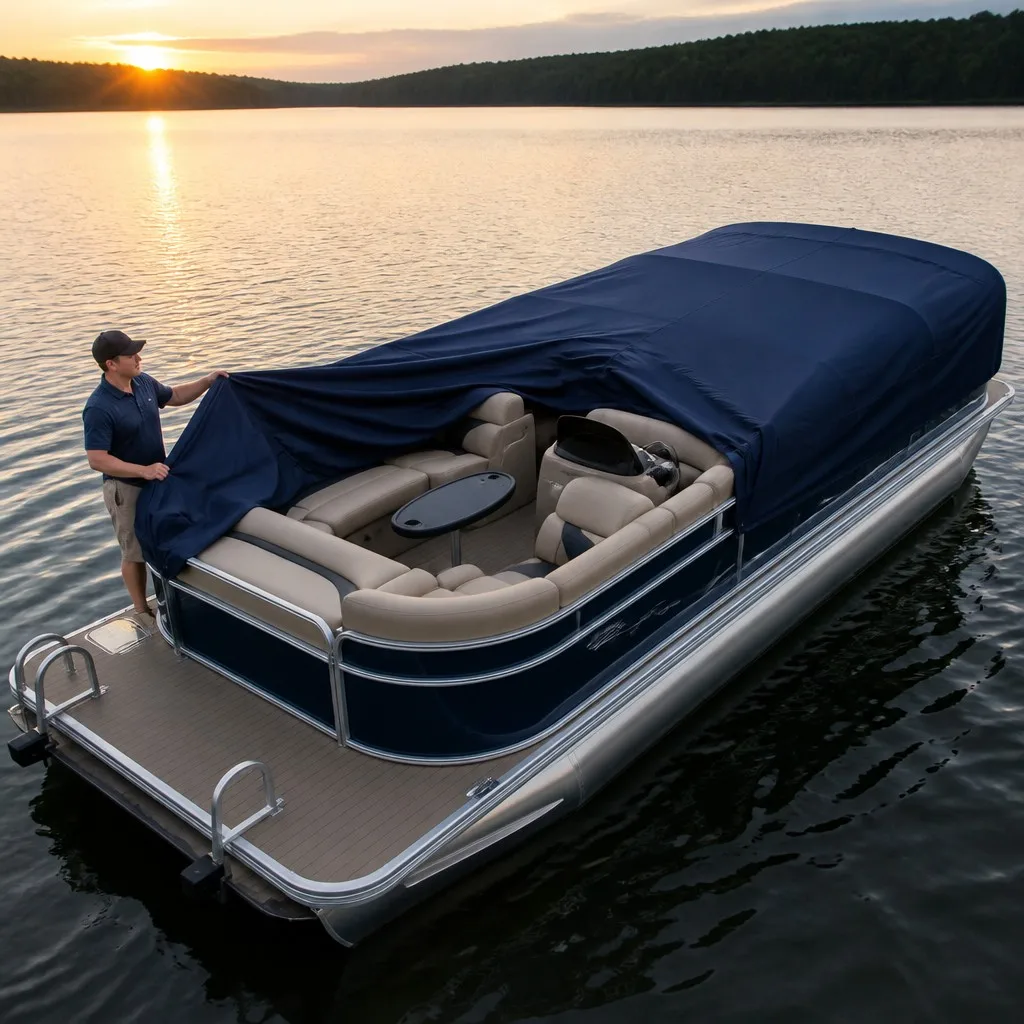
A Floating Living Room Deserves Real Protection
Pontoon boats have become the family boat of choice for one simple reason: they are comfortable. Plush lounge seating, marine-grade vinyl, cushioned flooring, and room for the whole crew — it is literally a living room that floats. That comfort comes at a price: a fully loaded tritoon is a serious financial commitment, and every component is exposed to sun, rain, wind, and spray. The good news is that with the right care routine and the right cover, a pontoon can look new for a decade or more. As a manufacturer of custom marine covers, JK Covers builds protection specifically for this category.
The Vulnerability Map of a Pontoon
Pontoons fail in predictable places. The furniture vinyl is the most expensive single surface on the boat — a full replacement upholstery job can cost as much as a used car. The decking, whether marine carpet, vinyl flooring, or EVA, degrades under UV and stays damp after rain. The rails and bimini hardware chafe against anything that rubs them. Even the tubes themselves need protection from sun-crazing and waterline staining. Each surface needs a different kind of defense, and all benefit from being covered when the boat is not in use.
Sun Is the Number One Enemy
UV radiation breaks down vinyl polymers at a chemical level: the plasticizers that keep upholstery soft evaporate, the color fades, and the surface eventually cracks. A pontoon docked in open water all summer absorbs thousands of hours of direct sun. A quality cover with UV-stabilized fabric blocks the majority of that radiation before it ever reaches the vinyl. This is why we treat UV protection as a fabric-science requirement, not a marketing feature — see [Link to Article 55: 600D vs 900D Oxford Fabric] for how we verify UV life in the lab.
Why Pontoons Need Custom-Fit Covers, Not Tarps
A pontoon is the hardest shape in boating to cover with a stock product. The deck is a wide rectangle, the furniture rises in irregular heights, the bimini folds but does not disappear, and the rails run around the entire perimeter. A flat tarp draped over that geometry sags into pools, chafes against rail tops, and flails in wind until the grommets tear out. A custom-fit pontoon cover is engineered around the actual layout: it accounts for furniture height, rail clearance, and bimini position, and it carries an integrated tensioning system that keeps the fabric drum-tight. The result is a cover that sheds water instantly, stays put in storms, and never touches the vinyl hard enough to abrade it. For OEM and ODM programs, we build pontoon patterns in 600D for moderate climates and 900D Oxford for full-time outdoor year-round exposure, always with a soft inner liner so the fabric itself is paint- and vinyl-safe.
Fabric Science: The Right Cloth for the Job
Not all "waterproof" fabric is created equal. Marine pontoon covers should be built from Oxford polyester in 600D or 900D with a durable water-repellent coating, plus non-negotiable details: air vents to release heat and humidity, double-stitched, tape-sealed seams so water cannot sneak through the needle holes, mildew-resistant backing, and marine-grade strapping with quick-release buckles. When we consult with OEM clients, we match fabric weight to storage conditions: 600D for a boat kept under a carport in a mild climate; 900D with reinforced webbing for full-time outdoor mooring in hot, stormy regions.
A Care Routine That Keeps the 'Living Room' New
Consistent care costs minutes and saves thousands. Rinse pontoons and deck with freshwater after every saltwater outing — salt residue pulls moisture into every seam. Clean vinyl with a dedicated marine cleaner and apply a UV protectant monthly; never use household bleach or abrasive pads. Sweep decking before covering so grit does not grind in, and check cover stitching monthly — a single loose thread can unravel into a tear. Store the boat covered whenever it is not in use, and let the cover dry before folding it for the season.
Building for the Pontoon Market
From the factory side, pontoons are one of our favorite categories because the engineering challenge is real: asymmetrical layouts, bimini hardware, and rail heights that vary by brand and year. Our measurement protocol captures the full deck profile, and our CAD patterns are prototyped and fitted on the actual hull class before production. That is the difference between a cover that hangs on the boat and a cover that fits it — and for retailers and brands sourcing pontoon covers, that fit is the difference between happy customers and warranty returns.
Designing a pontoon cover line for your brand? JK Covers offers custom-fit patterns, 600D/900D fabric options, and OEM/ODM manufacturing. Contact us to start the conversation.
0users like this.