Marine & Watercraft Gear

Winterizing Your Boat: The Ultimate Storage and Protection Checklist
The Off-Season Is When Boats Get Hurt
Ask any marine technician what the busiest season is and the answer surprises most owners: spring, when boats come out of storage with cracked blocks, fouled fuel systems, and corroded wiring. That damage was done months earlier, slowly, while the boat sat unused. Winterizing is a preservation procedure for a serious investment — not a chore to rush through. At JK Covers, we manufacture marine protection for OEM and retail brands and have watched the same preventable failures repeat for decades. This checklist covers every system on your boat, with special attention to the cover that will stand between it and a full season of weather.
Step 1: Engine, Fuel, and Fluid Systems
The engine is where most winter damage hides. A fuel system left full of untreated gasoline will varnish and clog injectors by spring; one left nearly empty invites condensation that turns into water in the tank. Add a marine-grade fuel stabilizer and run the engine long enough to circulate it through the entire system. Then fog the cylinders with fogging oil, change the engine oil and filter, and drain and replace the lower-unit gear oil so any water contamination is removed before it can freeze. Finally, drain raw-water systems and either blow them dry or fill them with non-toxic antifreeze — trapped water that freezes can crack a block or an outdrive housing.
Step 2: Electrical, Batteries, and Electronics
Cold temperatures accelerate battery self-discharge, and a deeply discharged battery can freeze and crack its case. Remove batteries and store them on a smart maintainer indoors, and remove portable electronics and chartplotters where humidity cannot attack the circuit boards. Spray exposed connectors with a corrosion inhibitor and check terminals for oxidation. Winter is also the best time to inspect wiring for chafed insulation.
Step 3: Deep Clean and Dry
Never cover a dirty or damp boat. Salt residue left on the hull pulls moisture out of the air and accelerates gelcoat degradation. Give the boat a thorough freshwater wash, paying attention to the bilge, scuppers, and every compartment where water collects. Wax the gelcoat so it enters storage with a protective sacrificial layer. Open hatches and lockers, and run a dehumidifier or leave desiccant bags inside the cabin for several days before covering. A dry boat under a breathable cover stays dry; a damp boat under any cover becomes a mold farm. See [Link to Article 60: Breathability vs Waterproofness] for why trapped moisture is the most common cause of mildew damage in stored boats.
Step 4: The Cover — Your Boat's Winter Coat
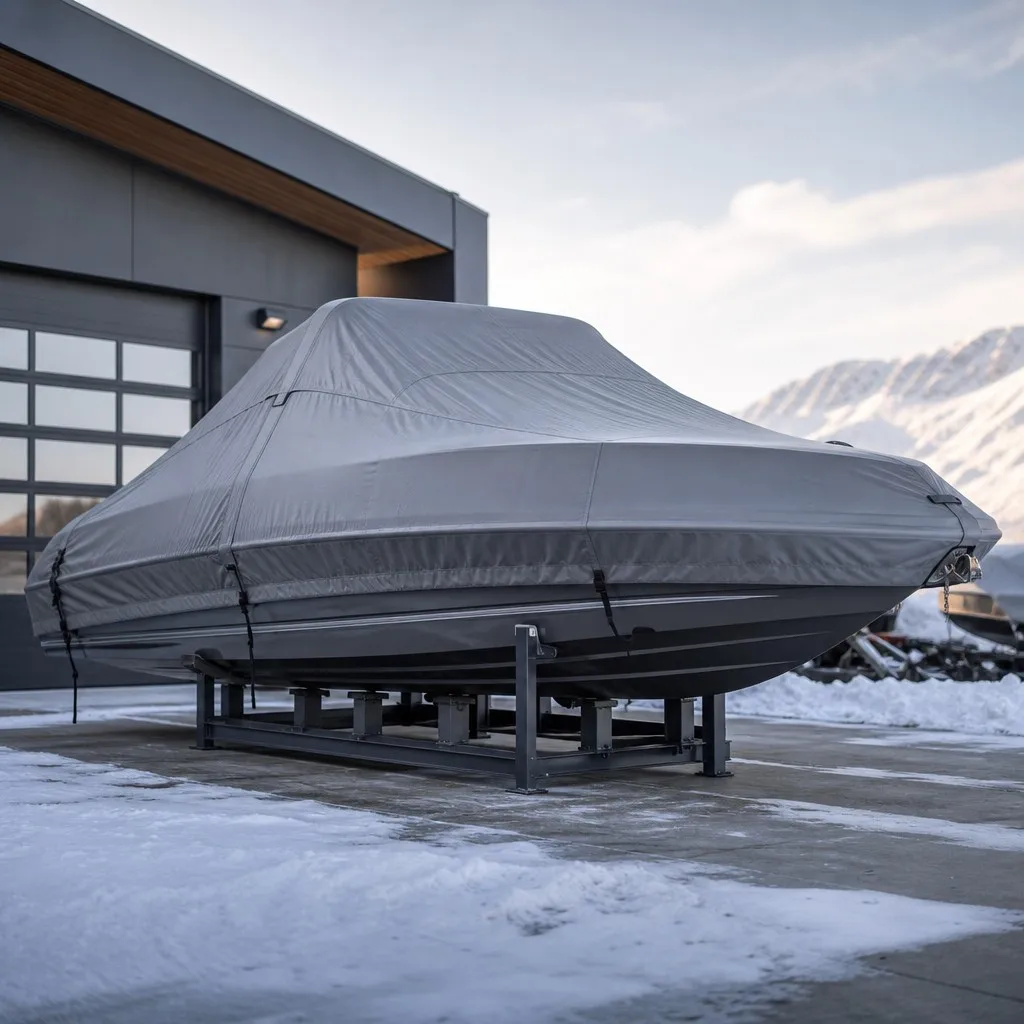
Your cover is the only barrier between the boat and months of rain, snow, ice, and UV. A generic tarp is not a winter cover: it pools water, flaps in wind, and abrades the gelcoat at every contact point. Invest in a purpose-built cover in 600D or 900D Oxford polyester with a waterproof coating, integrated air vents, and a reinforced hem with adjustable straps. Higher denier — 900D — is the right call for exposed outdoor storage in snow and ice regions, where the fabric must shed heavy loads without tearing. A custom-fit cover is strongly preferred for winter: it carries a smooth crown that sheds snow and water instead of collecting it, and it keeps the fabric from chafing against cleats and antennas. If your boat will sit outside, add a center support pole or a fitted frame so the cover can never sag into a pond.
Indoor vs. Outdoor Winter Storage
Indoor storage is always the first choice for protecting gelcoat, upholstery, and electronics. If it is not an option, outdoor storage demands the best cover money can buy plus a few precautions: cover the outdrive with a lower-unit cover, pad every sharp corner, and check the cover after major storms — snow load is a real force, and a cover with support poles distributes it instead of collapsing onto the windshield.
The Manufacturer's View: Why Custom Fit Wins in Winter
From our production line, the difference between a stock cover and a custom pattern is visible in every seam. We build winter-grade covers with double-stitched, tape-sealed seams, heavy-duty webbing straps, and buckle systems that survive wind without whipping. For OEM and ODM partners, we engineer patterns from actual hull measurements — accounting for windshield height, antennas, and outboard geometry — so the cover drapes tight enough to shed weather but never so tight it stresses the fabric. A cover that fits is a cover that lasts; that single principle drives the highest winter survival rates we see in field returns.
Preparing your fleet for winter? JK Covers manufactures custom-fit, winter-grade boat covers in 600D and 900D Oxford for brands and boatyards. Contact us for OEM and wholesale supply.
0users like this.